

Key takeaways
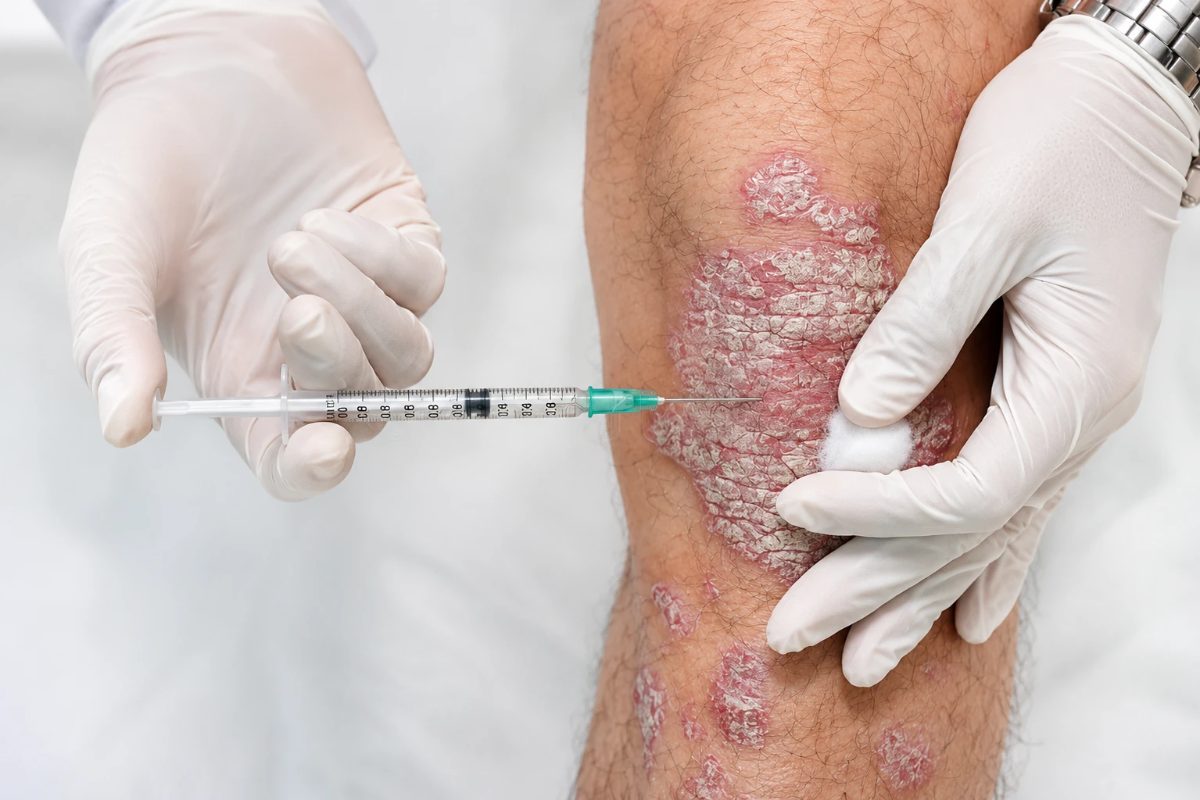
Biologics (injections or drips that block one immune messenger) and newer tablets such as JAK, PDE4 and TYK2 inhibitors can control moderate to severe psoriasis and atopic dermatitis in many people whose disease has not settled on creams, or who have had side effects from long-term steroids. For pemphigus, rituximab given with a shorter course of oral steroids is now a recommended first-line option in Indian guidelines. Several are approved and available in India, including lower-cost biosimilars, but cost and supply vary, so the choice is made one patient at a time, with a dermatologist.
Why do steroids stop working, or start causing harm?
Steroids calm inflammation quickly but do not switch off the disease underneath, so the rash usually returns when they are stopped, and long, unsupervised use can thin the skin and create dependence.
Corticosteroids (“steroids”) are among the most useful medicines in dermatology. Used in the right strength, on the right area, for the right length of time, they are safe. Problems begin when a strong cream is used for months, on the face or skin folds, or when tablets are repeated every time the disease flares.
What long-term steroid use can do
- Skin thinning (atrophy), stretch marks, easy bruising and visible small blood vessels.
- Rebound: the rash flares back, often worse, within days of stopping. This drives people to restart the cream, and a cycle of dependence begins.
- Steroid-damaged face: redness, burning, acne-like bumps and sensitivity to sun and heat after months of steroid creams on the face.
- From tablets or injections: weight gain, raised blood sugar and blood pressure, bone thinning, cataract, infections, disturbed sleep and mood.
If this sounds like your story, it is not your fault. Most patients we meet were simply trying to get relief. The answer is not to stop everything overnight, but to plan a supervised step-down while another treatment takes over.
What is the difference between a biologic and a small-molecule drug?
A biologic is a molecule, usually given by injection, that blocks one specific immune messenger outside the cell; a small-molecule drug is a tablet or cream that slips inside the cell and turns down the signal there.
Biologics
Biologics are antibodies made in living cells. They are injected under the skin with a pen or syringe, or given as a drip (infusion) in a day-care setting, anywhere from every 2 weeks to every 12 weeks, depending on the drug. A biosimilar is a highly similar, approved version of a biologic made after the original patent ends; it works the same way and usually costs less.
Small molecules
- JAK inhibitors (Janus kinase inhibitors, such as upadacitinib, baricitinib and tofacitinib) block a relay station inside cells that several cytokines use. They are tablets and often work quickly.
- PDE4 inhibitors (apremilast tablets; crisaborole cream) raise a natural “brake” on inflammation inside immune cells. They are milder but need little blood monitoring.
- TYK2 inhibitors (deucravacitinib) block one specific member of the JAK family that carries the IL-23 signal in psoriasis.
At a glance
| Drug class | Examples | Used for |
|---|---|---|
| TNF blockers | etanercept, adalimumab, infliximab (biosimilars in India) | Psoriasis, psoriatic arthritis |
| IL-17 blockers | secukinumab | Psoriasis, psoriatic arthritis |
| IL-23 and IL-12/23 blockers | ustekinumab, guselkumab, risankizumab, tildrakizumab | Psoriasis |
| Anti-CD6 | itolizumab (developed in India) | Psoriasis |
| IL-4/IL-13 blocker | dupilumab | Atopic dermatitis (also asthma) |
| JAK inhibitors | abrocitinib, upadacitinib, baricitinib, tofacitinib | Atopic dermatitis; psoriatic arthritis (tofacitinib) |
| PDE4 inhibitors | apremilast (tablet), crisaborole (cream) | Psoriasis, psoriatic arthritis; mild–moderate eczema (cream) |
| TYK2 inhibitor | deucravacitinib | Psoriasis |
| Anti-CD20 | rituximab | Pemphigus |
When should someone with psoriasis consider a biologic or targeted tablet?
A biologic or targeted tablet is worth discussing when psoriasis is moderate to severe, affects hard-to-treat areas, comes with joint pain, or has not settled on, or cannot safely continue, creams, phototherapy and conventional tablets.
Psoriasis is not only a skin disease. It is linked with psoriatic arthritis, and with diabetes, high blood pressure, fatty liver and heart disease, and it affects sleep, work and mood. That is why treatment is judged on how much of your life it affects, not just how much skin is involved.
Signs that it may be time to step up
- Plaques over a large area of the body, or the disease keeps returning within weeks of stopping treatment.
- Scalp, face, palms, soles, nails or genitals are involved, small areas that cause large distress.
- Joint pain, morning stiffness, a swollen finger or toe, or heel pain.
- Methotrexate, cyclosporine, acitretin or phototherapy has not worked, has caused side effects, or is unsuitable (for example, liver disease or plans for pregnancy).
Oral steroids are generally avoided in psoriasis, because stopping them can trigger a severe flare, including pustular psoriasis.
Main options available in India
Indian guidance and practice include TNF blockers (with biosimilars of etanercept and adalimumab), the IL-17 blocker secukinumab and the Indian-developed anti-CD6 antibody itolizumab.
In trials, a large share of patients reached 90% or greater clearance.
What are the newer treatment options for atopic dermatitis and eczema?
For moderate to severe atopic dermatitis that is not controlled by good skin care and prescription creams, the main newer options are the injectable biologic dupilumab and oral JAK1 inhibitors such as abrocitinib and upadacitinib.
Atopic dermatitis (atopic eczema) is a long-term condition in which the skin barrier is weak and the immune system overreacts, causing dryness, intense itch and flares. Daily moisturisers, gentle bathing, avoiding triggers and steroid-sparing creams such as tacrolimus remain the foundation, even on newer treatment.
Itch, poor sleep and stress feed each other. My co-authored study of adults with atopic dermatitis examined how the disease relates to perceived stress.
Biologic: dupilumab
Dupilumab blocks the IL-4 and IL-13 signals behind eczema-type inflammation. It received marketing authorisation in India in 2023 for adults with moderate to severe atopic dermatitis.
Adolescents and children
Some of these medicines are approved for adolescents, and for young children.
How has treatment for pemphigus changed?
Rituximab, which removes the B cells that make the harmful antibodies in pemphigus, combined with oral steroids, is now a recommended first-line option for moderate to severe pemphigus in Indian guidelines, and lets many patients reach remission with much less steroid.
What rituximab changed
- In a landmark French trial, first-line rituximab with a short course of prednisone led to more patients in complete remission off treatment, with fewer serious steroid side effects, than prednisone alone.
I have co-authored research on ultralow-dose rituximab as an add-on to standard care, and on the problems to watch for after rituximab, early flares, skin infections and low antibody levels.
Are biologics and JAK inhibitors safe? What tests are needed first?
For carefully selected and monitored patients, these medicines have well-studied safety records, but every one of them needs screening before the first dose, above all for tuberculosis and hepatitis B, which are common in India.
Are these treatments available in India?
Many of these medicines are approved by India’s drug regulator (CDSCO) and available, including Indian-made biosimilars that lower the cost; the exact price depends on the drug, dose, body weight and duration, and supply of some newer agents changes, so we confirm availability at your visit.
- How long: psoriasis and atopic dermatitis are long-term conditions. Many patients stay on treatment for years; some can space out doses once the skin is stable. Pemphigus treatment is usually given in cycles.
What happens at a first consultation at Pigment Skin Clinic?
At a first consultation in Shela, Ahmedabad, Dr. Kathak Patel reviews your full treatment history, examines your skin, scalp, nails, mouth and joints, scores how severe the disease is, and explains every suitable option, including older, affordable ones, before any screening tests are ordered.
- Your history: every cream, tablet and injection you have used. Bring the tubes, strips or photos of them, and old prescriptions and reports.
- Examination and scoring: standard severity scores (such as PASI for psoriasis, EASI for eczema, PDAI for pemphigus), a quality-of-life score, and photographs with your consent, so progress can be measured.
- Options: we discuss conventional and newer treatments, expected benefits, risks, cost and how often you would need to visit.
- Steroid plan: if you depend on steroids, a supervised plan to reduce them safely.
- Screening and follow-up: tests if a targeted medicine is chosen, and a clear follow-up schedule.
Consultations are available in English, Hindi and Gujarati.
Related care at the clinic: laser treatment for melasma and pigmentation, removal of moles, skin tags and warts, and our article on why melasma keeps coming back. Read more about Dr. Kathak Patel.
Frequently asked questions
Are biologics safe for long-term use?
For most carefully screened patients, yes. Many biologics have been used for more than 15 years, and long-term safety data are reassuring when TB and hepatitis are checked first and follow-up is regular. Your dermatologist will weigh your own medical history before choosing one.
Will I have to take a biologic for life?
Not necessarily. Psoriasis and atopic dermatitis are long-term conditions, so many people stay on treatment for years, but some can space out doses once the skin is stable. Stopping should always be planned with your dermatologist, because the disease can return.
Is a JAK inhibitor better than a biologic?
Neither is better for everyone. JAK inhibitors are tablets and often work quickly but need more blood tests and a careful look at heart and clot risk; biologics are injections with less monitoring. The right choice depends on your disease, age, health, preferences and budget.
Can I stop my steroid cream suddenly once I start a new treatment?
Usually not. Stopping strong steroid creams abruptly can cause a rebound flare. Your dermatologist will reduce them step by step while the new treatment starts working.
Are biologics available in Ahmedabad?
Yes, several biologics and targeted tablets are available in India, including in Ahmedabad, and some have lower-cost biosimilar versions. Supply of individual medicines changes, so availability is confirmed at your consultation.
Do biologics weaken the immune system?
They turn down one part of the immune system rather than the whole of it. This slightly increases the risk of some infections, especially TB, which is why screening comes first. Most people continue normal life, work and travel.
Can I take these medicines during pregnancy or while trying for a baby?
Some can be used with care and others must be stopped months beforehand. Tell your dermatologist as early as possible if you are planning a pregnancy, are pregnant or are breastfeeding, so the plan can be adjusted safely.
Can children with severe eczema get these treatments?
Some newer medicines are approved for adolescents and young children in other countries, and Indian approvals may be narrower. A dermatologist will consider the child’s age, severity and growth, often together with the paediatrician.
Is rituximab a kind of chemotherapy?
Rituximab is a targeted antibody, not traditional chemotherapy. It was first used in certain blood cancers, but in pemphigus it is given at different doses to remove the cells that make the harmful antibodies. It does need screening and monitoring for infection.
Will I need regular blood tests?
It depends on the medicine. JAK inhibitors and some biologics need blood tests before starting and at intervals afterwards, while dupilumab usually does not need routine blood tests. Your dermatologist will give you a written schedule.
Still on steroids and not getting better?
A consultation can tell you whether a newer treatment suits you, and what to do safely in the meantime.
Medical disclaimer. This article is for general education only. It is not a substitute for a consultation and examination by a qualified doctor who knows your medical history. Do not start, stop or change any medicine without medical advice.