

Key takeaways
JAK inhibitors are once-daily tablets (such as abrocitinib, upadacitinib and baricitinib) that turn down the immune signals driving eczema. In trials they relieved itch within days and cleared skin in many adults with moderate to severe atopic dermatitis. For the right person, they are an effective option when creams and older tablets have failed.
What are JAK inhibitors and how do they work in eczema?
JAK inhibitors are small-molecule tablets that block Janus kinase enzymes, relay stations inside immune and nerve cells that carry the itch and inflammation signals of atopic dermatitis.
In eczema, the skin’s protective layer is weak and the immune system overreacts, sending out chemical “alarm” signals that cause redness, dryness and itch. Many of these signals pass through JAK enzymes inside the cells. A JAK inhibitor blocks this relay, so several itch and inflammation signals are turned down at once, which is why many people feel less itchy within days or weeks.
Steroids calm inflammation broadly wherever they are applied or taken, and with long use they can thin the skin and affect the whole body. JAK inhibitors are more targeted: they turn down only the specific signals that drive eczema and itch, and they do not thin the skin.
Which JAK inhibitors are used for eczema, and what is available in India?
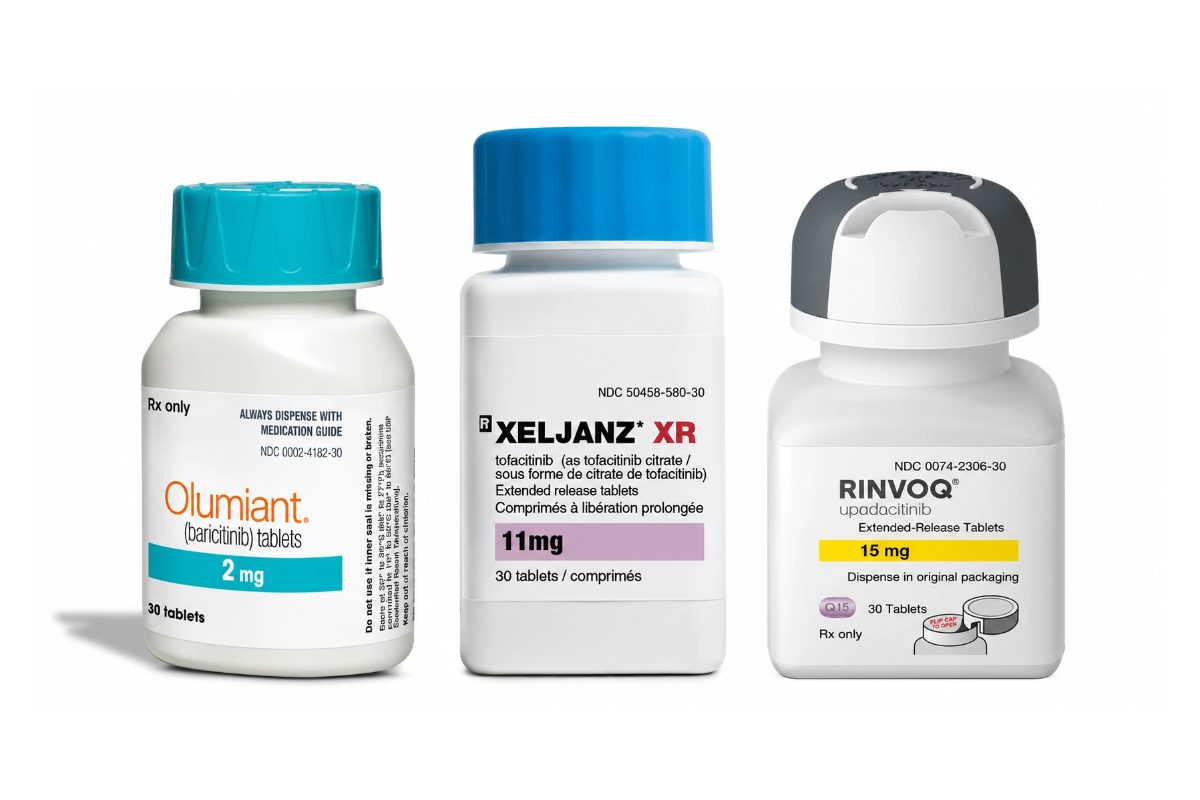
The JAK inhibitors studied for atopic dermatitis are abrocitinib, upadacitinib and baricitinib; abrocitinib has Indian marketing authorisation for adults, and others are used depending on local approval and supply.
| Medicine | Type | How it is taken |
|---|---|---|
| Abrocitinib | Selective JAK1 | Tablet once daily |
| Upadacitinib | Selective JAK1 | Tablet once daily |
| Baricitinib | JAK1/JAK2 | Tablet once daily |
| Tofacitinib | Mainly JAK1/JAK3 | Tablet twice daily |
| Ruxolitinib, delgocitinib | JAK creams/ointments | Applied to the skin |
How well do they work?
In large trials, JAK1 inhibitors improved itch and skin clearance in a majority of adults with moderate to severe atopic dermatitis, often faster than the biologic dupilumab, though results vary from person to person.
Most people still need moisturisers and a mild cream for occasional patches. The aim we agree on is skin you are comfortable in, sleep that is no longer broken by itch, and as little steroid as possible.
What are the common side effects?
The most common side effects are mild: nausea, headache, acne, colds, and raised cholesterol or muscle enzyme on blood tests; shingles and cold sores are more frequent than usual, and serious problems are uncommon.
How are you monitored once treatment starts?
You will usually have a review and blood tests about four weeks after starting or changing the dose, then every few months, with cholesterol checked after about three months.
When the skin has been stable for some time, the dose can often be reduced. Stopping completely usually lets eczema return, so any change is planned together.
Who is, and who is not, a good candidate?
A good candidate is an adult or eligible adolescent with moderate to severe atopic dermatitis that has not been controlled by good skin care, prescription creams and usually at least one older tablet, and who has no major heart, clot, cancer or infection risk.
Often a good fit
- Eczema that keeps returning after steroid courses, or steroid side effects you want to avoid.
- Severe itch and poor sleep, where fast relief matters.
- Cyclosporine or methotrexate has not worked, caused side effects or is unsuitable.
- A preference for tablets over injections.
I have used JAK inhibitors in complex inflammatory skin disease beyond eczema, including published work on tofacitinib as an add-on in a severe leprosy reaction. That experience reinforces a simple rule: the screening and follow-up are as important as the tablet.
How do JAK inhibitors compare with other options?
JAK inhibitors work quickly and are tablets, but need more monitoring; dupilumab is an injection with very little monitoring; cyclosporine and methotrexate are older, affordable tablets with their own side effects.
- Dupilumab: injection every two weeks, no routine blood tests, eye irritation is common; available in India.
- Cyclosporine: works fast but is limited to short periods because of kidney and blood-pressure effects.
- Methotrexate: slower, affordable, needs blood tests; not for pregnancy.
- Phototherapy: requires visits two to three times a week.
Cost and supply matter in India. We discuss the cost of a realistic course, not one strip, before you decide.
What happens at a consultation at Pigment Skin Clinic?
At a first visit in Shela, Ahmedabad, Dr. Kathak Patel reviews your treatment history, scores how severe your eczema is, checks your health risks, and explains whether a JAK inhibitor or another option suits you, before any tests are ordered.
- Bring all creams and tablets you have used (or photos), past prescriptions and recent blood reports.
- Assessment with standard scores (EASI and an itch and sleep score) and photographs with your consent.
- Options discussed openly, including benefits, risks, monitoring and cost.
- Screening tests if a JAK inhibitor is chosen, and a written follow-up schedule.
Consultations are available in English, Hindi and Gujarati. If long-term steroid creams have affected your face, see our article on topical steroid damaged face. Read more about Dr. Kathak Patel.
Frequently asked questions
Are JAK inhibitors safe for eczema?
For carefully selected and monitored people, they are considered an effective and acceptably safe option. The main warnings concern heart events, blood clots, cancer and infections, which are more likely in older people, smokers and those with heart risk factors. Screening and regular blood tests reduce the risk.
Do JAK inhibitors cause cancer?
In a large study of older people with rheumatoid arthritis and heart risk factors, tofacitinib was linked with slightly more cancers than TNF blockers. Whether the same applies to younger people with eczema is not certain. People with a history of cancer usually choose another option.
How quickly do JAK inhibitors work for eczema?
Many people notice less itching within the first few days to two weeks, and skin improvement over the following weeks. Your dermatologist will review the response at about 12 weeks.
Can I stop my steroid cream once I start a JAK tablet?
Usually you reduce it gradually rather than stopping overnight. Many people keep a mild cream for occasional patches and continue moisturisers every day.
Will I have to take the tablet for life?
Not necessarily. Once the skin has been stable for some time, the dose can often be reduced, and some people take breaks. Eczema can return after stopping, so changes are planned with your dermatologist.
Can teenagers take JAK inhibitors?
Some are approved for adolescents aged 12 and over in other countries, but Indian approvals may be narrower. A dermatologist will consider age, severity, growth and vaccines, usually with the family and paediatrician.
Can I take a JAK inhibitor if I am planning a pregnancy?
No. JAK inhibitors are avoided in pregnancy and breastfeeding. If you are planning a pregnancy, tell your dermatologist early so the treatment can be changed in good time.
Is a JAK inhibitor better than dupilumab?
Neither is better for everyone. JAK tablets often relieve itch faster but need more blood tests; dupilumab is an injection with less monitoring. The choice depends on your health, preferences, cost and supply.
Do I need blood tests on a JAK inhibitor?
Yes. Blood tests are done before starting, at about four weeks, and then every few months, including blood count, liver tests and cholesterol.
Can I get vaccines while on a JAK inhibitor?
Most non-live vaccines can be given. Live vaccines are avoided during treatment, so it is best to catch up on vaccines before starting.
Eczema still not controlled after steroids?
A consultation can tell you whether a JAK inhibitor or another treatment suits you, and what tests come first.
Medical disclaimer. This article is for general education only. It is not a substitute for a consultation and examination by a qualified doctor who knows your medical history. Do not start, stop or change any medicine without medical advice.